







You need to bring your own bike on all of our Ride25 cycling holiday and events.
This page is designed to give you guidance on choosing a bike that’s right for the Ride25 trip that you’ll be joining us on. Right for the terrain, the distance, and your body shape (and that won’t cause or aggravate any injuries!).
Our biggest tips:
[accordion clicktoclose=true tag=h3]
[accordion-item title=”What type of bike is suitable for
multi-day tours like Ride25?”]
We have chosen routes on roads and paths that are suitable for road bikes so having a road bike will make the trip much easier, particularly when going up some of the longer ascents.
However, hybrids or mountain bikes are perfectly fine as long as they do not have suspension. There are a couple of reasons for this:
Tandem bikes are more than welcome, and we’ve even had a team of people in the past complete their trip using Brompton bikes! We wouldn’t recommend using a unicycle.
The most important thing is that whatever bike you bring along, you should feel comfortable using it and be able to carry out basic maintenance on it. We strongly recommend having ridden it on training rides before Ride25 to check you’re happy!
[/accordion-item]
[accordion-item title=”How many gears do I need?”]
We recommend at least 10 gears to give you a comfortable range between the lowest (the so called ‘granny gear’ for climbing) and the highest (that keeps you going at high speeds).
When you sign up for a Ride25 you’ll be sent information about the routes and you can plan training rides accordingly to make sure your gears are suitable for the types of terrain and elevation you’ll be riding on.
[/accordion-item]
[accordion-item title=”You mentioned basic maintenance:
what do I need to know how to do?”]
Although there are qualified bike mechanics in the support crew of every Ride25 (see here for more details), being able to do some roadside repair yourself will prevent you from having to wait for the mechanics to arrive, meaning you can get yourself riding more quickly!
We suggest that you learn how to:
Nothing too intricate or fiddly, and it should only require a couple of tools in your saddle bag.
We recommend each cyclist (or at least one person in each group) carry tyre levers, a pump, and an Allen key. Spare inner tubes are a must as well.
[/accordion-item]
[accordion-item title=”What adjustments can I make to
ensure the bike is set-up correctly for me?”]
Go to a decent bike shop and get it set-up so that it is optimised for your own body shape and size. Minor changes can make a big difference.
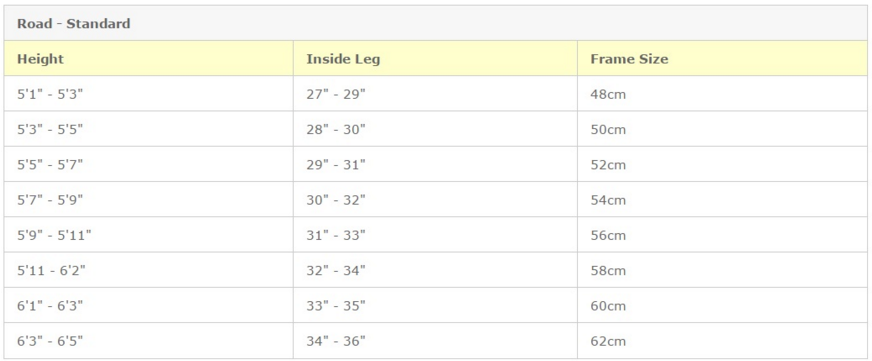
The top level consideration is whether your bike is the right size. Each frame size is designed for a different body size, according to the table below:
Other things to think about:
Staff at a bike shop will be able to assist with this, or you can opt for a professional fitting.
Our recommended bike fitter is Cyclometrics.
[/accordion-item]
[accordion-item title=”What happens if my bike isn’t set-up correctly?”]
It will feel uncomfortable to ride and you’ll most likely be putting in more effort than you need to. For short rides (to the shops and back) this isn’t necessarily a problem, but on long rides or multi-day cycling holidays, you’re more likely to cause an injury.
Common injuries in cycling occur in the neck, back, knees and hands. Different factors cause and aggravate each type of injury, and your body shape and previous injuries will have an impact to. This is why we recommend talking to a bike shop or having a bike fit: there is no one-size-fits-all solution.
[/accordion-item]
[accordion-item title=”Apart from my bike, what do I need
to bring with me?”]
See our packing list page for the full kit, but some things that are specifically related to your bike are outlined below:
[/accordion-item]
[accordion-item title=”How do I transport my bike?”]
You will need to plan how to get your bike to the starting point and back home again.
We recommend hiring a bike box through our friends at Polaris or Bike Box Online.
We’ve also put together a comprehensive guide to airlines’ bike transit policies which will help you make an informed decision on which airline to use when transporting your bike. It’s worth noting that budget airlines usually charge extortionate excess luggage fees, so paying more for a ticket with a better airline that offers free carriage of your bike can sometimes
work out cheaper.
[/accordion-item]
[/accordion]
We’ve written a bunch of posts on our blog that might be useful as further reading when getting your bike prepared for a long tour.
This handy guide teaches you how to pack your bike down, which can be fiddly if it’s your first time!
Our comprehensive guide of over 80 airlines’ bike transit policies, including cost and packing requirements, should prove useful when planning how to get your bike to the starting line!
Our friend and Ride25 tour crew member Smudge, has written some great content explaining some common injuries that can arise while cycling, and how to reduce your risk:
If reading about potential injuries isn’t up your street, why not take a look at an interview with Guy Cox, who rode our Milan to Rome leg on a Brompton.
Here are some useful links related to things discussed on this page.